About 30 years ago, I discovered Saltaire, just outside
Bradford. I honestly believed that no one else in the world knew about it.
It was clearly a small Victorian town, planned along, almost
US type grid lines.... and seemed to have been built to house mill workers at what was then, 30 years ago, the
completely derelict Salts Mill.

I was fascinated. I saw two cassocked priests playing
badminton over a net strung between lampposts on the drive way up to the rather
gorgeous church.....but apart from them, I saw hardly anyone.
 |
| No badminton playing vicars when I took this photo....but those are the lamp posts where they had strung the net. |
Many of the houses were boarded up, the patches of green,
between the derelict mill and factory buildings were overgrown, and the whole
place had a feeling of the Marie Celeste.
However...the historian (well, history teacher) in me,
recognised something special about the place.
The mill buildings were huge...the biggest I had ever seen. I
later discovered that it had been the biggest factory in Europe when it was
built.

The houses were solid, good Victorian stone buildings. They
had interesting and decorative arched window
and door features. Each street contained dozens of small 2 up 2 down artisan
classic well built terraced houses, but at each end of the street were larger,
more imposing buildings.


Lamas featured heavily.....and a few other woolly looking
beasts...alpaccas..they featured on coats of arms hidden within the grime of
the buildings.


All of this could have been seen from the huge windows in
the main factory building. My understanding of 19th century factory
conditions, was that workers were not encouraged to look out of windows. In
fact most would have had very little natural light to have worked by. They
slaved away at their looms for 12 -14 hours a day,no looking out of windows allowed.
Everything I saw smacked of Victorian
philanthropy......decent solid houses for workers, a factory with light, and
views of the hills and the sky, somewhere for workers to worship, to meet and
socialise, to walk at the weekend, out of the city.
It did all fit. As it happened I apparently had not
discovered Saltaire. Possibly, a bit like Columbus did not discover America.
In the church I found a brief poorly produced leaflet
explaining how Titus Salt had envisaged this model town for the workers in his
factory. He wanted his workers to be healthy, partly for his own benefit of course, but also because he was genuinely philanthropic.The church, where Titus is buried, was finished before anything else, and although workers
were allowed a day off, and the park was built for them....they were not
allowed to drink alcohol anywhere in Saltaire. There were no licensed premises...no
beer halls for Titus’s workers.
The streets were named after his children, and the larger
houses, dotted along each street were for the factory supervisors. So the
workers were supervised at work and at play.
He imported exotic south American fibres and contributed
massively to the Yorkshire textile industry....and his own wealth.
Now of course..... 30 years from my discovery......Saltaire
is a tourist destination. The fabulous redeveloped Salts Mill is the centre for
a fabulous Hockney gallery. Brilliant use has been made of the vast floor space
that was the original mill building. Beautiful books, art, pottery, rugs and
tapestries can be viewed and bought there. Operatic arias played on the ground
floor gallery fill the space, accompanying the tourists looking at the Hockneys
.Gorgeous meals can be eaten in the lovely restaurant on the top floor, diners
able to look out across the mill roof, and to the hills beyond.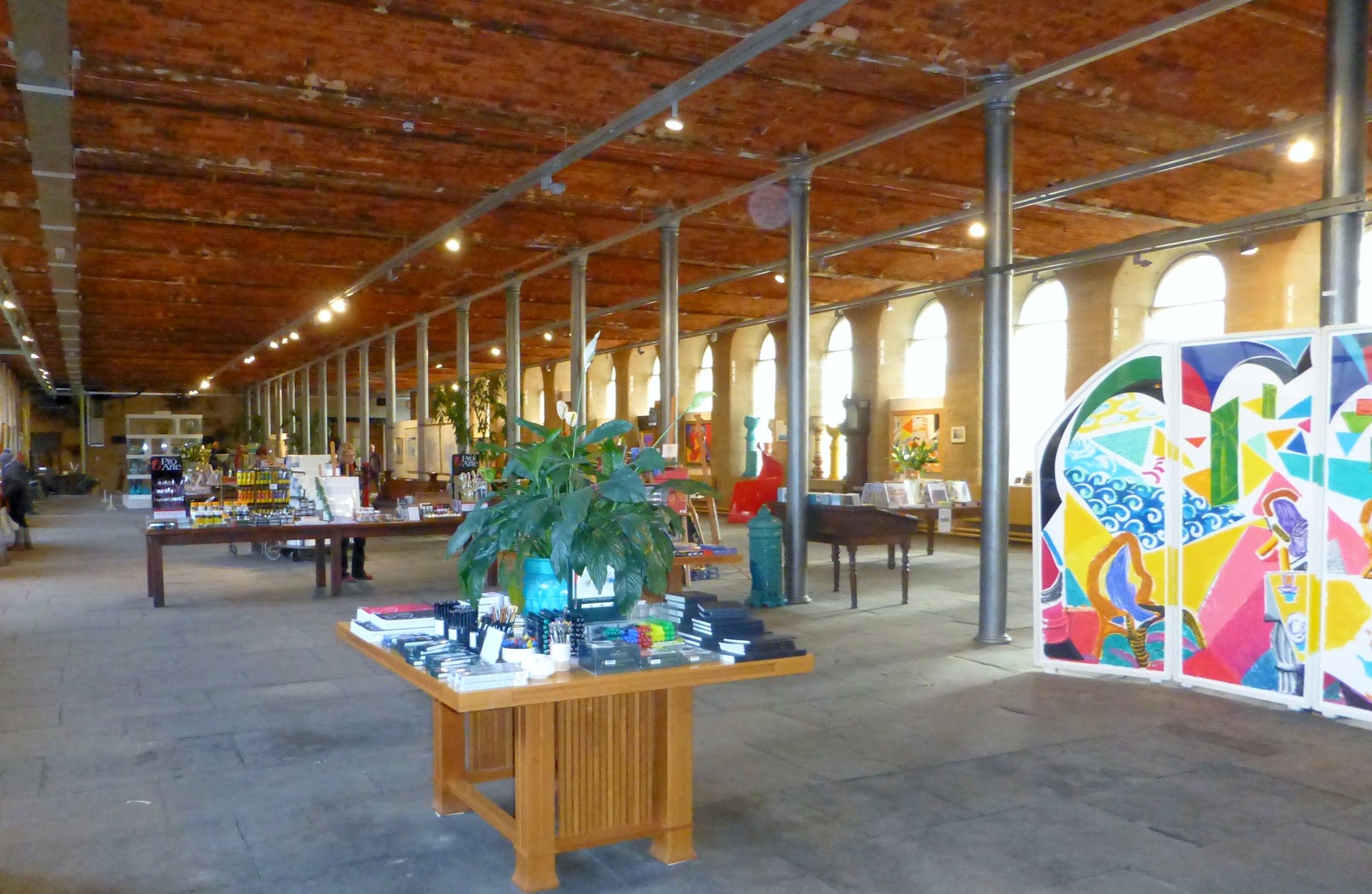
 |
Mark, browsing....imagining those looms. |
Now, it is also possible to drink alcohol within the town
boundaries.....and a clever wine bar owner has called his bar “ Dont tell Titus”.
I love this place, partly because it represented real
improvement in living and working conditions for Bradford’s textile workers,
albeit for Titus Salt’s profit.....but mainly because I discovered it.